
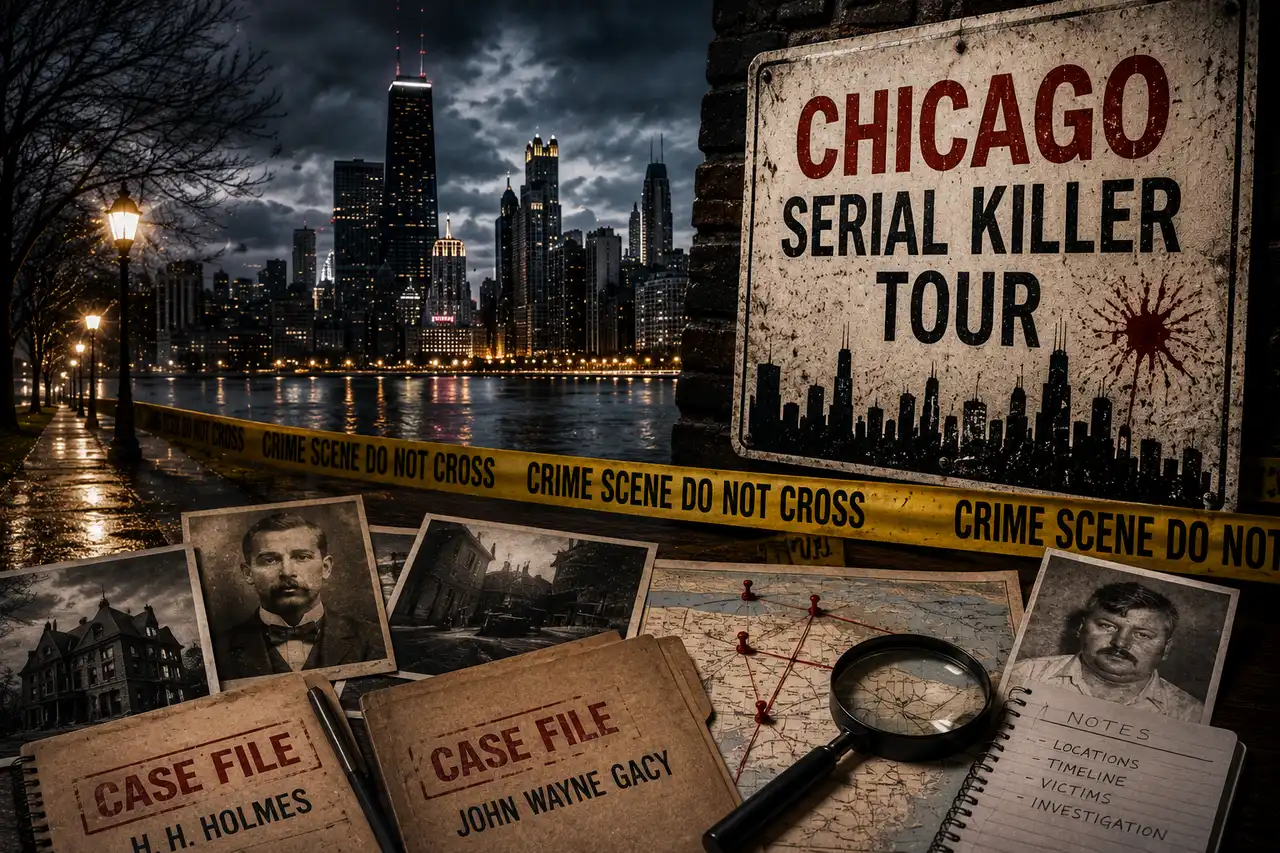
Chicago is famous for architecture, blues, food, museums, sports, and its spectacular skyline.
But the city also has a darker history.
Some of America’s most notorious criminal cases have connections to Chicago and the surrounding region.
For true crime enthusiasts, learning about these cases at the locations connected with the events can provide a very different experience from listening to a podcast or watching a documentary.
A Chicago serial killer tour explores that history through storytelling, locations, investigations, and the real people behind cases that shocked the country.
Here’s what you should know before going.
Why Chicago Has Such a Strong Connection to True Crime
Chicago has been a major American city for well over a century.
Its rapid population growth, industrialization, transportation networks, political history, and enormous geographic footprint have produced countless stories—both inspiring and disturbing.
Some criminal cases became nationally famous.
Others faded from public memory.
True crime tours bring selected stories back into their geographical context.
You aren’t simply hearing what happened.
You’re seeing where parts of the story unfolded.
H.H. Holmes and the World’s Fair Era
Few Chicago crime figures have generated more legends than H.H. Holmes.
Holmes operated a building in Englewood during the period surrounding the 1893 World’s Columbian Exposition.
Over time, newspapers and later storytellers transformed the building into the infamous “Murder Castle.”
Stories described secret passages, traps, gas chambers, hidden rooms, and extraordinary numbers of victims.
The reality requires more careful examination.
Holmes was unquestionably a murderer and fraudster, but historians have challenged many of the sensational claims repeated about him.
That makes his story particularly interesting for modern true crime audiences.
Separating documented history from newspaper sensationalism becomes part of the mystery.
The Problem With the “Murder Castle” Legend
H.H. Holmes is a perfect example of why responsible true crime storytelling matters.
Claims that he murdered enormous numbers of World’s Fair tourists have been repeated for generations.
However, historical researchers have questioned many of these stories.
Some supposed victims were later discovered to still be alive.
Other dramatic details appear to have grown through sensational newspaper coverage.
The documented story remains disturbing without requiring embellishment.
A well-researched tour should help visitors understand both the crimes and the mythology surrounding them.
John Wayne Gacy
Another case closely associated with the Chicago area is John Wayne Gacy.
Gacy was convicted in 1980 of murdering 33 young men and boys.
His crimes occurred primarily in the Chicago suburbs rather than downtown Chicago.
The case became especially shocking because of the contrast between Gacy’s public persona and his private crimes.
He operated a contracting business and participated in community activities while concealing a horrifying pattern of violence.
The investigation that exposed his crimes remains one of the most notorious cases in American criminal history.
True Crime Is About More Than the Killer
Responsible true crime storytelling shouldn’t turn criminals into heroes or celebrities.
The most meaningful approach also considers:
- The victims
- Families and communities
- Investigators
- Historical context
- Evidence
- Media coverage
- Myths that developed later
Understanding these elements turns a sensational story into a more complete examination of history and criminal investigation.
What Happens on a Chicago Serial Killer Tour?
Exact routes and stories depend on the tour, but a true crime experience may combine transportation, historical locations, photographs, narration, and detailed explanations of important cases.
Rather than presenting disconnected facts, guides can explain how locations, people, investigations, and historical events connect.
This context is what makes an in-person experience different from reading about a case online.
Is a Serial Killer Tour Scary?
That depends on what you find scary.
This isn’t a haunted house.
The disturbing aspect comes from knowing that the stories involve real events and real people.
Standing near a location connected to a historical crime can feel very different from seeing the same place on television.
Visitors who already enjoy true crime podcasts, documentaries, criminal history, or investigative stories are likely to find the experience particularly interesting.
Is the Tour Suitable for Children?
True crime subject matter can include murder, violence, and disturbing historical details.
Parents should consider the maturity and sensitivity of younger participants before choosing this type of experience.
Families looking for a more general introduction to Chicago may prefer a traditional sightseeing experience instead.
What Should You Bring?
You don’t need much.
Comfortable clothing and footwear are useful, particularly if your experience includes walking portions.
Depending on the season, Chicago weather can change significantly, so check conditions before leaving.
Most importantly, bring questions.
True crime experiences become much more interesting when visitors engage with the history instead of simply listening passively.
Why Take a Guided Tour Instead of Exploring Alone?
You can certainly research Chicago crime history independently.
But there are two challenges.
First, many historic locations have changed dramatically or disappeared completely.
Without context, you might pass a significant location without realizing what happened there.
Second, the internet is filled with repeated myths and inaccurate crime stories.
A research-focused guide can help distinguish documented evidence from popular legend.
True Crime and Historical Accuracy
The best true crime experiences don’t need to exaggerate.
The real cases are compelling enough.
H.H. Holmes is an especially important example because sensational claims surrounding his story have been repeated for more than a century.
Understanding which details are documented—and which may have originated in sensational journalism—makes the story more interesting, not less.
History becomes an investigation of its own.