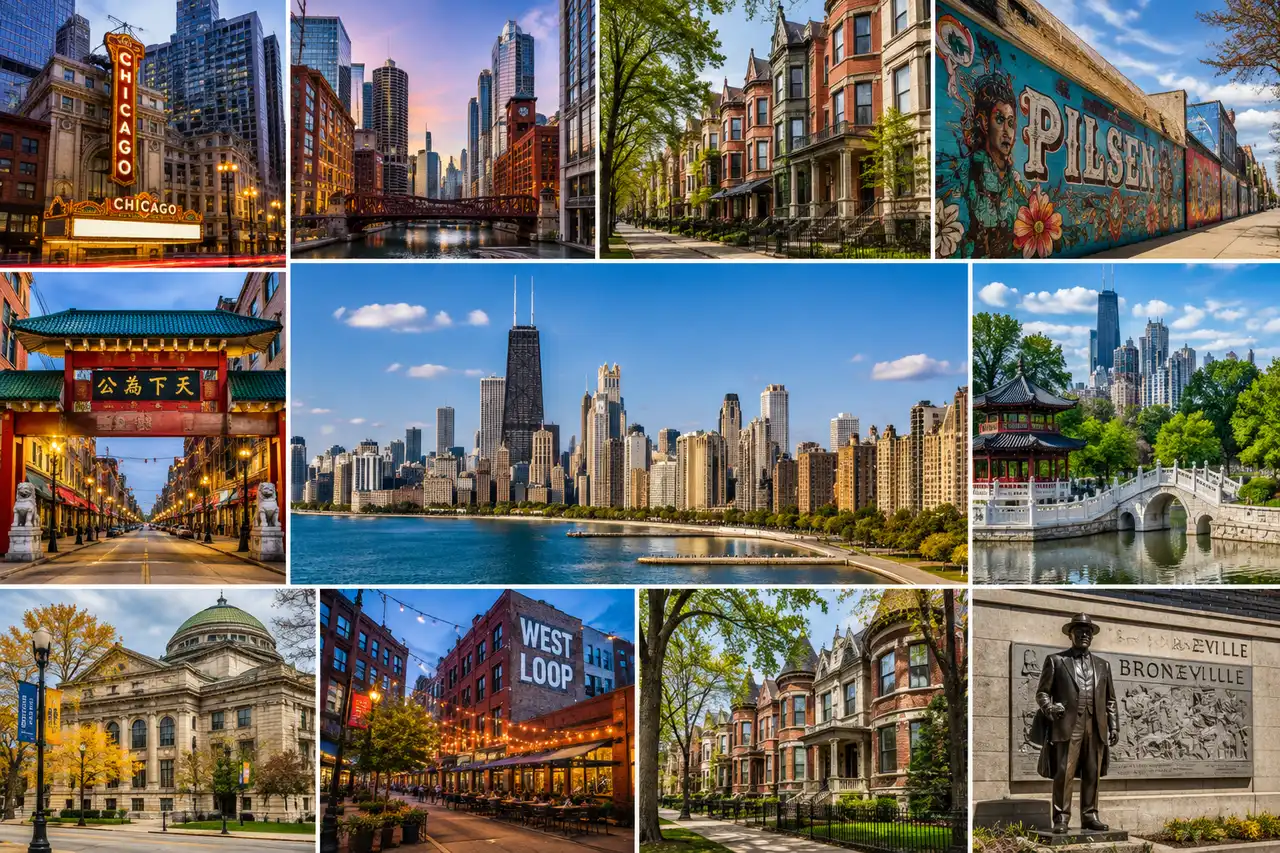
Downtown Chicago may have the famous skyline, but understanding the city means exploring beyond the Loop.
Chicago is famously a city of neighborhoods, with 77 officially designated community areas and countless smaller neighborhood identities.
Each offers something different.
You can spend the morning surrounded by historic architecture, eat lunch in a neighborhood shaped by generations of immigrants, explore colorful murals in the afternoon, and finish your evening surrounded by live music.
Here are several Chicago neighborhoods worth adding to your itinerary.
1. The Loop
For first-time visitors, the Loop is the natural starting point.
This is the historic and commercial heart of downtown Chicago.
Major attractions in and around the area include Millennium Park, Cloud Gate, the Chicago Cultural Center, the Art Institute of Chicago, historic theaters, and some of the city’s most impressive skyscrapers.
The elevated CTA tracks that circle part of downtown also give the Loop its name and distinctive urban character.
Best for: First-time visitors, architecture, landmarks and history.
2. River North
Cross the Chicago River from the Loop and you’ll enter River North.
The neighborhood combines restaurants, nightlife, galleries, hotels, historic buildings, and modern skyscrapers.
It’s also conveniently located near the Magnificent Mile and Chicago River.
River North is particularly lively in the evening, making it a popular area for visitors who want restaurants and entertainment within walking distance.
Best for: Dining, nightlife and downtown convenience.
3. Lincoln Park
Lincoln Park offers a very different side of Chicago.
Tree-lined residential streets, historic homes, restaurants, boutiques, parks, and lakefront scenery give the neighborhood a more relaxed atmosphere.
The neighborhood is also home to Lincoln Park Zoo, one of Chicago’s best-known family attractions.
Visitors who want a break from downtown skyscrapers can spend several hours walking through the park and surrounding streets.
Best for: Families, parks, architecture and relaxed exploring.
4. Wicker Park and Bucktown
Wicker Park and Bucktown have long been associated with Chicago’s creative side.
The area offers independent stores, restaurants, nightlife, music venues, street art, and distinctive residential architecture.
Milwaukee Avenue runs through the heart of the neighborhood and provides an excellent route for exploring on foot.
Best for: Shopping, nightlife, food and creative culture.
5. Pilsen
Pilsen is one of Chicago’s most visually distinctive neighborhoods.
The area is strongly associated with Mexican American culture and is known for colorful murals, galleries, restaurants, and community institutions.
Walking through Pilsen reveals enormous public artworks covering building walls and viaducts.
The neighborhood demonstrates how Chicago’s cultural history continues to evolve through immigration, art, food, and community life.
Best for: Murals, Mexican culture, food and art.
6. Chinatown
Chicago’s Chinatown offers visitors another opportunity to experience the city beyond its downtown core.
Restaurants, bakeries, shops, public art, and cultural landmarks fill the neighborhood.
Chinatown Square provides a central gathering point, while nearby Ping Tom Memorial Park offers beautiful views toward downtown.
Come hungry.
Exploring the neighborhood’s restaurants is an important part of the experience.
Best for: Food, culture and photography.
7. Hyde Park
Located on Chicago’s South Side, Hyde Park combines history, architecture, education, museums, parks, and lakefront scenery.
The neighborhood is closely associated with the University of Chicago and is home to the Museum of Science and Industry.
It also played an important role in the story of the 1893 World’s Columbian Exposition.
For visitors interested in architecture and Chicago history, Hyde Park offers plenty to explore.
Best for: Museums, history and architecture.
8. Bronzeville
Bronzeville is one of the most historically significant African American communities in Chicago.
During the Great Migration, the area became an important center of Black business, music, art, publishing, and culture.
Exploring Bronzeville provides important context for understanding Chicago’s cultural history beyond the better-known downtown attractions.
Best for: African American history, culture and architecture.
9. Old Town
Old Town combines historic residential streets with restaurants, entertainment, and nightlife.
Parts of the neighborhood offer a glimpse of the smaller-scale Chicago that existed before skyscrapers transformed downtown.
The area is also strongly associated with Chicago comedy and live entertainment.
Best for: Historic atmosphere, entertainment and nightlife.
10. West Loop
The West Loop demonstrates how dramatically Chicago neighborhoods can change.
Once dominated by warehouses and industrial businesses, the area has evolved into one of the city’s best-known dining and entertainment districts.
Old industrial buildings now stand alongside new residential and commercial developments.
Nearby Fulton Market is especially popular for restaurants and nightlife.
Best for: Restaurants, nightlife and modern urban Chicago.
Which Chicago Neighborhood Should You Visit?
That depends on what interests you.
For iconic attractions, start with the Loop.
For food and nightlife, consider River North or the West Loop.
For art and culture, explore Pilsen.
For history, Hyde Park and Bronzeville deserve attention.
For parks and residential architecture, Lincoln Park is an excellent choice.
And if you have several days in Chicago, visit more than one.
Don’t Spend Your Entire Trip Downtown
Chicago’s famous downtown attractions deserve their reputation.
But they tell only part of the story.
The city’s neighborhoods reveal how generations of residents built communities around culture, architecture, food, music, industry, and migration.
That’s where Chicago begins to feel less like a collection of attractions and more like a living city.