Chicago’s skyline is more than a collection of impressive buildings. It is a visual history of ambition, disaster, engineering, creativity, and reinvention.
Walk through downtown Chicago today and you’ll encounter buildings representing more than a century of architectural experimentation. Historic masonry structures stand beside Art Deco towers, modernist landmarks, and contemporary glass skyscrapers.
But Chicago’s architectural story becomes especially interesting when you understand why the city became such an important place for architects in the first place.
The Great Chicago Fire Changed the City
One of the defining events in Chicago history occurred in October 1871.
The Great Chicago Fire devastated a large portion of the city, destroying thousands of buildings and leaving roughly 100,000 people without homes.
The disaster was catastrophic, but Chicago rebuilt rapidly.
As reconstruction continued, architects and engineers experimented with new materials and construction methods. After another major fire in 1874, building regulations increasingly encouraged more fire-resistant materials such as brick and stone.
Over the following decades, Chicago became a laboratory for new ideas about how cities could grow upward.
The Birth of the Skyscraper
As Chicago’s population and economy expanded, downtown land became increasingly valuable.
Building upward offered an obvious solution.
Completed in 1885, the Home Insurance Building is widely recognized as one of the earliest skyscrapers.
Designed by William Le Baron Jenney, the building used an innovative metal-frame structural system that helped support its weight.
Instead of relying entirely on thick exterior masonry walls, this approach helped pave the way for taller buildings with larger windows and more usable interior space.
The Home Insurance Building was eventually demolished, but its influence can still be seen in cities around the world.
The Chicago School of Architecture
Chicago soon became associated with a generation of architects who were reconsidering what tall commercial buildings should look like.
Rather than disguising height, many architects began emphasizing it.
Large windows brought more natural light into offices, while structural advances allowed buildings to rise higher.
Architects working in and around Chicago helped establish ideas that influenced modern architecture far beyond the city.
Louis Sullivan and a New Philosophy
Louis Sullivan became one of the most influential figures in early skyscraper design.
His work helped establish the idea that a building’s exterior should reflect its purpose and structure rather than merely imitate historical European styles.
Sullivan also influenced a young architect who would later become internationally famous: Frank Lloyd Wright.
Chicago therefore became connected not only with the development of skyscrapers but with broader changes in architectural thinking.
Frank Lloyd Wright and Chicago
Frank Lloyd Wright developed much of his early architectural philosophy in the Chicago area.
His Prairie School designs emphasized horizontal lines, open interior spaces, natural materials, and a stronger relationship between buildings and their surroundings.
Visitors interested in architecture can still explore numerous Wright-designed properties throughout the Chicago region.
His work provides a fascinating contrast to the vertical skyscrapers rising downtown during the same general period.
The Wrigley Building
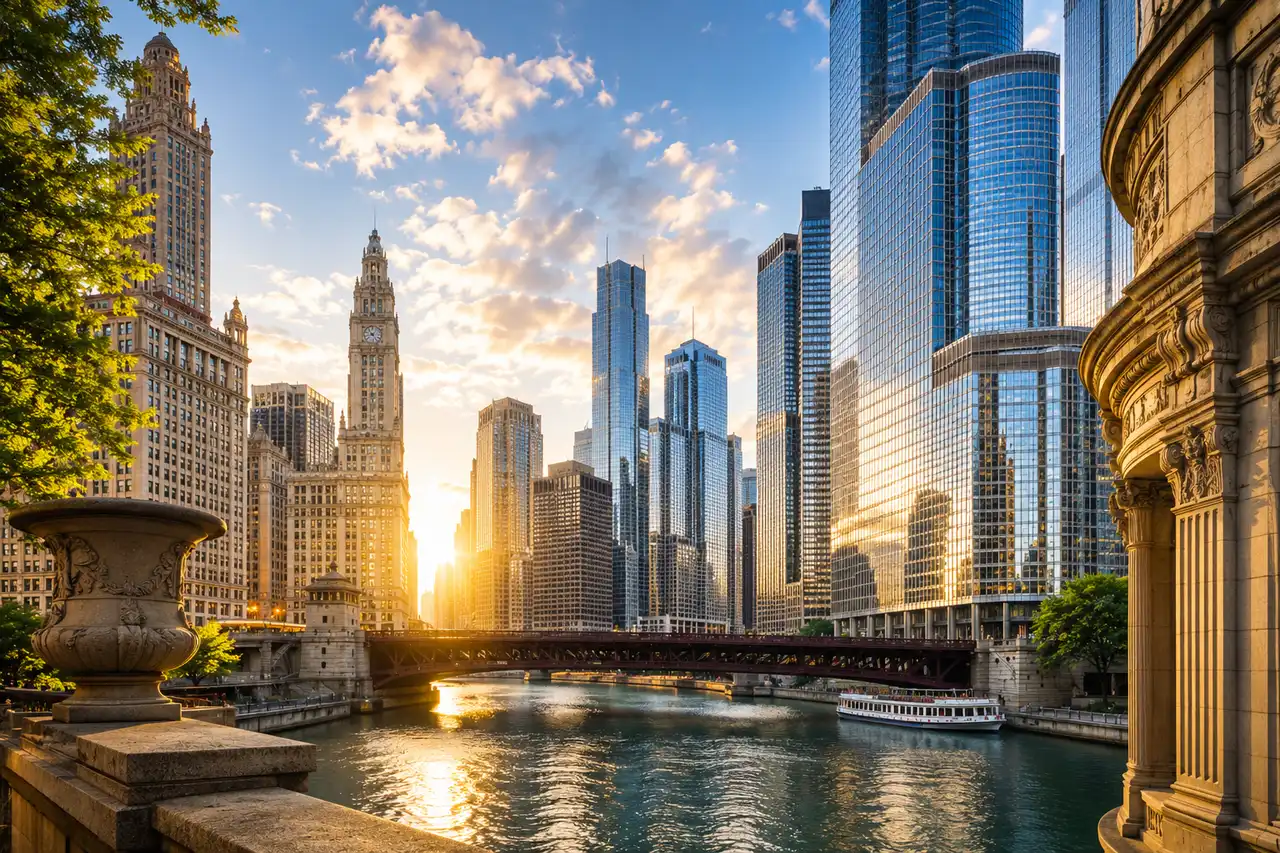
The Wrigley Building is one of the most recognizable structures along the Chicago River.
Its bright terra-cotta exterior and distinctive towers make it particularly striking when illuminated at night.
Located near the Michigan Avenue Bridge, it also forms part of one of Chicago’s most photographed architectural scenes.
Standing there today offers an excellent view of how different periods of Chicago architecture coexist within just a few blocks.
Tribune Tower
Across Michigan Avenue stands Tribune Tower.
Its Gothic Revival appearance makes it dramatically different from many surrounding skyscrapers.
One of its most unusual features is the collection of fragments associated with historic sites and structures from around the world embedded into portions of the exterior.
It is the kind of architectural detail visitors can easily overlook unless they know where to look.
Marina City
Chicago’s architectural experimentation continued into the modern era.
Marina City, with its distinctive cylindrical towers and semicircular balconies, became one of the city’s most recognizable mid-century developments.
Its unusual appearance earned the towers their famous nickname: the “corn cobs.”
The complex reflected a larger idea about urban living—creating residential, commercial, entertainment, and parking spaces within one development.
Willis Tower
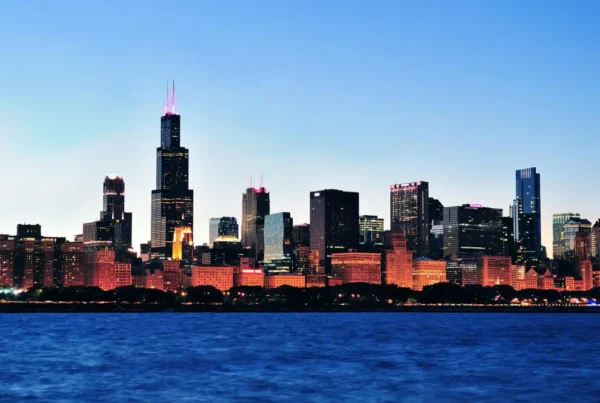
Completed in the 1970s as Sears Tower, Willis Tower transformed Chicago’s skyline.
For decades, it held the title of the tallest building in the world.
Its distinctive bundled-tube structural system allowed the enormous tower to achieve remarkable height while remaining structurally efficient.
Today, the building remains one of Chicago’s defining landmarks.
Chicago Architecture Along the River
One of the best places to appreciate the city’s architecture is along the Chicago River.
Within a relatively short distance, visitors can see structures representing numerous architectural periods.
Historic buildings sit beside glass towers, converted warehouses, modern hotels, residential skyscrapers, and office buildings.
The result is almost like an outdoor architecture museum.
Why Chicago Architecture Is Different
Chicago architecture is remarkable because the city did not develop during a single period.
Instead, generations of architects continually added new ideas.
The skyline reflects:
- The rebuilding that followed the Great Chicago Fire
- The development of early skyscrapers
- The Chicago School
- Art Deco design
- Mid-century modernism
- Postmodern architecture
- Contemporary sustainable design
Few cities provide such a visible timeline of architectural development within one downtown area.
Look Up When Exploring Chicago
Chicago rewards visitors who pay attention.
Decorative carvings, historic signs, unusual windows, hidden entrances, rooftop details, and architectural references are everywhere.
Sometimes the most interesting building on a block isn’t the tallest or most famous one.
Understanding these details can transform a walk through downtown into a journey through more than a century of American architectural history.